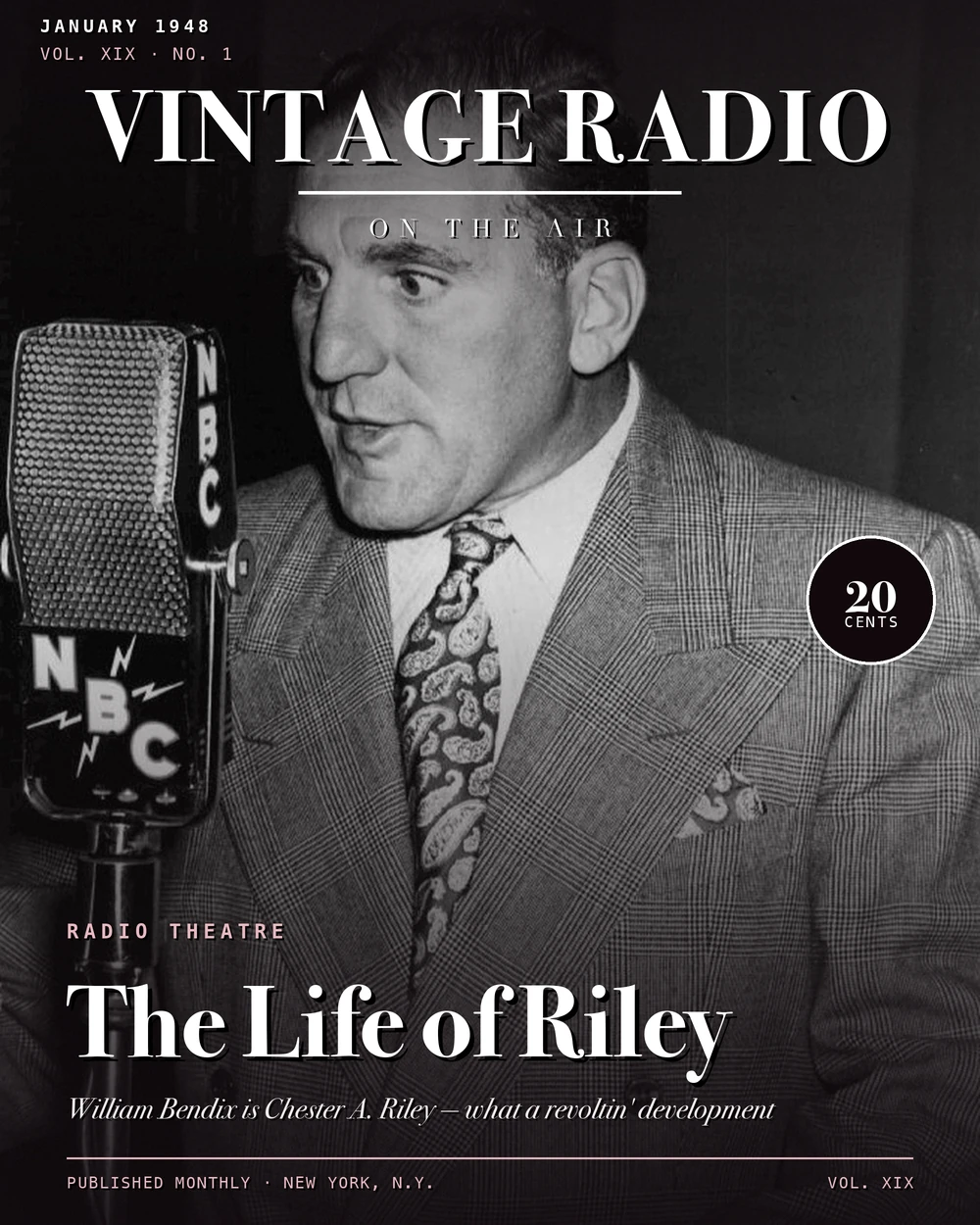
The Life of Riley
How a Groucho Marx Flop Became Chester A. Riley
The Life of Riley didn't start as The Life of Riley. It started as The Flotsam Family, a prospective vehicle for Groucho Marx, and it died at the audition stage when the would-be sponsor refused to put Groucho in a straight domestic role as the head of a household. The concept sat there, apparently going nowhere, until producer Irving Brecher saw William Bendix in a film called The McGuerins of Brooklyn and decided he'd found exactly the man he was looking for. A new audition was recorded with Bendix in the lead, the character was renamed Chester A. Riley, and the show that eventually ran for the better part of a decade on NBC was underway. Brecher developed the property with Gummo Marx — the nonperforming Marx brother turned talent agent — who took a story credit and stayed attached to it through its various incarnations.
That origin story matters because it tells you something about what Riley was. The character only worked if the audience believed he was a genuine working man in over his head — not a comedian doing a bit, but a real, thick-shouldered guy trying his best and coming up short. Bendix, who had come out of the New Jersey Federal Theater project, brought exactly that quality. He was a latecomer to acting: born in Manhattan in 1906, he had served as a batboy for both the Yankees and the Giants in his youth (and claimed to have watched Babe Ruth hit more than a hundred home runs), then run a grocery store that the Depression closed before he turned to performing at around 30. He made his Broadway debut in The Trial of Dr. Beck in 1937 and broke through playing the cop Krupp in William Saroyan's The Time of Your Life in 1939–40. His film career began in 1942 in a string of beefy tough-guy roles, including the one that earned him an Academy Award nomination for Best Supporting Actor in Wake Island that same year. Riley used all of that weight while giving the character somewhere to go emotionally.
Chester Riley, Riveter
On the NBC run that most listeners remember, Chester A. Riley was a riveter at Cunningham Aircraft, a fictional California plant — radio's resident hard-hat, as he was sometimes described — earning $59 a week and living at 1313 Blueview Terrace in a working-class neighborhood. His wife Peg, played by Paula Winslowe, put up with him with what the show treated as infinite patience. Their kids, Junior and Babs, went through a small rotation of actors over the years: Conrad Binyon and Sharon Douglas originated the roles, with Scotty Beckett, Jack Grimes, Bobby Ellis, and Tommy Cook all eventually taking turns as Junior, and Barbara Eiler stepping into Babs in January 1947.
Riley's character came out most clearly when something went wrong — a leaking roof, trouble at the plant, one of his children's problems landing in his lap. These situations sent him into a kind of bewildered pandemonium, and out of that chaos came the line that followed the show everywhere: "What a revoltin' development this is." It became a national catchphrase, the kind of phrase people started dropping into ordinary conversation, and it stuck to Bendix for the rest of his life. Marvel Comics eventually borrowed it for Ben Grimm, the Thing of the Fantastic Four. It was, by any measure, Bendix's best-remembered character.
The supporting cast gave Riley people to bounce off. John Brown played Gillis, Riley's coworker and pal, a role compared to that of a neighbor character on a domestic comedy but with more sarcasm in the mix. Shirley Mitchell played Honeybee Gillis. Hans Conried played Uncle Baxter, a permanent nonpaying houseguest whose chief distinction was that he had once loaned Riley a pint of blood and never once let him forget it. Charlie Cantor played Uncle Buckley, Francis "Dink" Trout played Waldo Binny, and the show drew on a deep bench of voice talent — Alan Reed, later famous as Fred Flintstone, turned up in multiple parts including Riley's boss Mr. Stevenson and Peg's father, and Mel Blanc voiced Junior's dog Tiger.
The Friendly Undertaker
The most unusual recurring character on the show was Digger O'Dell — also played by John Brown, making him the rare cast member carrying two distinct roles in the same series. Digger was an undertaker, good for one walk-on per episode, a brief exchange built entirely around black humor and mortuary jokes. Brecher knew he was treading carefully; death wasn't a subject radio comedy usually touched, and he handled the character with enough lightness that it came off as absurdist rather than morbid. The character was reportedly invented on the spur of the moment when a broadcast was running short, and the Leo Burnett agency initially demanded he be cut as being in bad taste — but the producer refused, and the public quickly settled the question.
Digger's entrance line was always a variation on the same theme: "You're looking fine, Riley—very natural." His exit ran the same direction: "Cheerio—I'd better be ... shoveling off." He spoke in what was described as a clammy baritone, and his jokes had a consistent deadpan logic to them, as when he observed that "the grass is always greener on the other fellow." The bit never overstayed its welcome, partly because it was rationed to one appearance per show. Because the program went out live before a studio audience and most listeners had no idea Brown played both Gillis and the undertaker, Digger's entrances were typically greeted with howls of laughter and applause from people taken by surprise. The character developed a particular following among people actually working in the undertaking profession, which may say something about the appeal of seeing your trade handled with affectionate absurdity rather than avoided altogether.
Three Networks, Three Runs
The show had a complicated broadcast history before it became the NBC staple most people remember. The first run aired on CBS from April 12 to September 6, 1941, with Lionel Stander playing a character named J. Riley Farnsworth — a rough-cut gadabout with a heart of gold, but bearing little resemblance to the later series. The CBS cast included Grace Coppin as an old maid named Maude, Jackie Grimes as her nephew Davie, and Peggy Conklin as Peggy, the daughter of the richest man in town and Riley's love interest. It was a different show in nearly every respect.
The second run moved to the Blue Network, later ABC, from January 16, 1944, to July 8, 1945, with the American Meat Institute as sponsor. This is where Bendix came in, the character became Chester A. Riley, and the show found the shape it would hold going forward.
The third and longest run began on NBC on September 8, 1945, and ran through June 29, 1951. Procter & Gamble sponsored the first stretch, from 1945 to 1949, advertising products including Teel and Prell, with Ken Carpenter announcing. Pabst Beer took over the sponsorship from 1949 to 1951, with Jimmy Wallington as announcer. The show aired on Saturdays at 8 p.m. through mid-1948, then shifted to Friday nights, moving between 9 and 10 p.m. over the remaining years. Lou Kosloff led the orchestra throughout the NBC run. Writers Alan Lipscott and Reuben Ship did much of the scripting, with additional work from Ashmead Scott, Robert Sloane, and Dick Powell — not the actor of the same name.
The Feature Film and the Television Tangle
In 1949, Brecher took Riley to the movies. The feature film version of The Life of Riley premiered in Cincinnati on March 5, 1949, with Bendix in the lead, Rosemary DeCamp as Peg, and Brecher himself directing. James Gleason played Gillis instead of John Brown, for the practical reason that having Brown carry both Gillis and Digger O'Dell would have required split-screen work the production didn't want to attempt. The picture grossed $1.6 million in the U.S. and Canada, and Bendix and DeCamp later reprised their parts in an hour-long adaptation on Lux Radio Theatre on May 8, 1950.
The film had a strange knock-on effect. Bendix's RKO contract prevented him from starring in a television version, so when a TV adaptation opened on NBC on October 4, 1949, Jackie Gleason got the role of Riley instead — a situation audiences apparently found difficult to accept with the Bendix radio version still on the air. Sid Tomack played Jim Gillis. John Brown reprised Digger O'Dell, making him the only member of the original radio cast to carry over. The Gleason version ran 26 episodes before Brecher and sponsor Pabst Brewing reached an impasse over extending it to a full 39-week season, and it expired on March 28, 1950. It did, however, win the first Emmy ever given for Best Film Made For and Shown on Television, beating out The Silver Theatre and The Lone Ranger — Groucho Marx picked up a story credit on the win.
Bendix eventually got his television version: a filmed NBC series that ran from January 2, 1953, to August 22, 1958. Marjorie Reynolds played Peg, Wesley Morgan played Junior, Lugene Sanders played Babs, and Tom D'Andrea took the Gillis role. Digger O'Dell didn't appear in this version — John Brown had been called before HUAC in 1952, declined to answer questions about Communist Party membership, and was placed on the Hollywood blacklist, which ended his career and ruled him out of the revival. The show ran five years, four of them in the Nielsen top 30, and gave Bendix the chance to play Riley on his own terms.
Legacy
Brecher himself was a substantial Hollywood figure independent of Riley. Born in the Bronx in 1914 and raised in Yonkers, he was the only writer ever to receive sole screenplay credit on two Marx Brothers films — At the Circus (1939) and Go West (1940) — and was among the uncredited hands on The Wizard of Oz the same year, work for which Groucho dubbed him "The Wicked Wit of the West." He earned an Academy Award nomination in 1944 for Meet Me in St. Louis and wrote Shadow of the Thin Man, Ziegfeld Follies, and Bye Bye Birdie among other pictures. After Riley wrapped, he co-produced The People's Choice with George Burns, the Jackie Cooper sitcom remembered for its basset hound Cleo, whose inner monologue only the audience could hear. Brecher died in 2008, and his memoir — titled, inevitably, The Wicked Wit of the West — came out posthumously the following January.
Radio historian Gerald Nachman, in Raised on Radio, places The Life of Riley among the handful of programs that took blue-collar family life seriously enough to build a comedy around it without condescension. Brecher's own description of his star, quoted in Nachman, was characteristically plain: "He was a Brooklyn guy and there was something about him." The Television Academy has noted that after Riley left the air, working-class protagonists of his type largely vanished from American television until the 1970s; the filmed TV series is also remembered as one of the rare vintage sitcoms to use no laugh track at all. Roughly 252 episodes of the Bendix radio run survive out of an original production estimated at 320 or so, enough to give a clear picture of the show at full stride.
Bendix died on December 14, 1964, in Los Angeles, of lobar pneumonia brought on by malnutrition from a chronic stomach ailment. He was 58, and it was said, with some affection, that he had always looked 58. He had been married to Theresa Stefanotti since 1927 — 37 years, until his death — and is interred at San Fernando Mission Cemetery in Mission Hills, California. He had played the lead a few years earlier in Rod Serling's The Time Element, a 1958 time-travel drama about a man trying to warn Honolulu about Pearl Harbor, and the success of that program is generally credited with clearing the path for The Twilight Zone. Not a bad postscript for a grocer who didn't start acting until he was 30.